Position & orient
Present parts at defined positions and set their orientation for the next process step.

INDUSTRIAL HANDLING
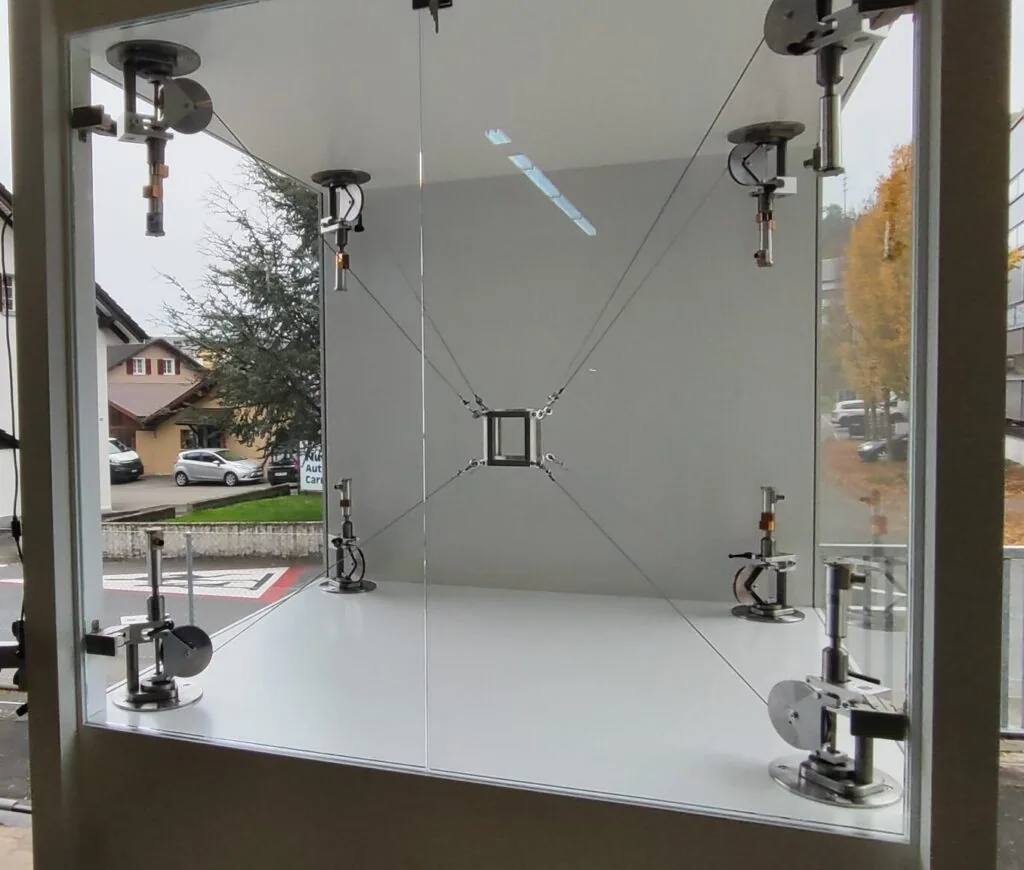
A flexible motion platform for different handling tasks. Gripper, workspace, payload and motion profile are matched to the part and installation process.
01 / VERSATILE HANDLING TASKS
These tasks define the intended applications. Suitability is assessed against the load case, tool and process.
Present parts at defined positions and set their orientation for the next process step.
Move components between storage, stations and processing areas. Transfer points and motion paths are defined together.
Machine tending as an application: grippability, access, obstacles and the machine interface determine the design.
Move and present parts or tools for assembly workflows. Process forces and accuracy require a separate assessment.
02 / WHEN TO ASSESS CABLE ROBOTICS?
A variable workspace, different transfer points or a lightweight moving platform can justify investigating cable robotics. Your task determines the decision.
Reachable positions, permissible cable tensions, payload including the gripper, vibration behaviour, cycle time and positioning accuracy. Supporting structure, supply lines and integration into the complete installation also matter.
The 500 × 500 × 500 mm reference workspace and stated print accuracy of up to 0.1 mm relate to printer development. They are not guaranteed handling specifications. Payload, cycle time and handling accuracy are determined for each application.
Technical fundamentals03 / YOUR APPLICATION
Dimensions, weight, centre of gravity and gripping points.
Transfer positions, travel, orientation and obstacles.
Target cycle, positioning requirement and permissible vibration.
Gripper, interfaces, access and the safety concept of the complete installation.
Define the workpiece, motion path, transfer points and target values together.
Evaluate geometry, cable forces, tool and interfaces for the load case.
Plan an agreed trial and assess target values through measurements.
QUESTIONS & ANSWERS
Development covers versatile industrial handling: positioning, transferring and presenting workpieces, loading and unloading machines, and moving parts or tools in assembly workflows. Gripper, load case and integration are designed for each task.
Useful inputs include part dimensions and weight, gripping points, transfer positions, motion paths and target cycle time and accuracy. Machine access, obstacles and required interfaces also form part of the application assessment.
Binding handling specifications are determined for each implementation. The published 500 × 500 × 500 mm workspace and print accuracy of up to 0.1 mm relate to printer development and are not guaranteed handling specifications.